
Let me start with something simple.
Imagine you walk into a hospital. Would you rather be treated by a doctor who knows a little bit about everything … or a specialist who has spent years focusing only on your exact problem? If it’s something serious, we want the specialist. The eye doctor. The neurologist. The expert.
Now here’s the interesting part. Tools like GPT can write essays, help with coding, explain science, draft emails, and even give life advice. One minute you’re asking it to explain black holes, the next you’re like, “Hey, can you also help me text my crush?” It’s impressive, almost magical at times. It feels like talking to someone who knows everything.
But if you’ve ever pushed it a bit further, asked it something very specific, very technical, or very real-world, you might have noticed something strange.
It still sounds confident. Even when it’s wrong. And that’s where the story begins.
When “Knowing Everything” Isn’t Enough
Let’s say you ask an AI about a complicated tax rule. Or a medical condition. Or a legal clause buried deep inside a contract. It will respond smoothly. Clearly. Convincingly.
But here’s the catch. It doesn’t actually know in the way a specialist knows. It’s more like someone who has read millions of books and is very good at guessing what the answer should sound like. That works surprisingly well… until it doesn’t.
It’s like asking a really smart friend who read Wikipedia all night to perform surgery. You’d enjoy the conversation, but you probably wouldn’t hand them the scalpel. And that’s exactly the limitation of general AI models.
They are incredibly broad. But they are not deep where it truly matters.
Enter Domain-Specific AI
Now imagine we take that same AI, but instead of letting it learn everything, we train it to focus on just one area.
Only medical records. Only financial data. Only legal documents. Only your company’s internal knowledge.
Suddenly, things change. This is what we call domain-specific AI. It’s the same AI, but focused on just one domain. And just like in real life, specialists tend to be much better at solving real problems.
Think of It Like This
Let’s use a simple analogy. A general AI model is like Google Maps for the entire world. It knows every country, every city, every road. But a domain-specific model is like a local guide in a small town. The map shows you where things are. The guide tells you where to go, what to avoid, and what actually matters.
And when you’re making important decisions, that difference matters a lot.
When Things Go Wrong (In the Real World)
This isn’t just a theoretical concern. We’ve already seen what happens when general AI models are used in situations where precision actually matters.
In 2023, a lawyer in the United States used ChatGPT to assist with legal research. The AI generated case citations that looked completely legitimate, but they didn’t exist. The court later sanctioned the lawyer after discovering that the cases were fabricated. What made it worse was how convincing the response sounded.
In another widely reported example, early testing of AI systems in healthcare settings showed that while the responses were fluent and helpful in tone, they sometimes missed critical clinical nuances.
Even outside high-stakes environments, smaller failures happen every day. Students rely on AI for explanations that are partially incorrect. Professionals use it to summarize documents and miss key details. People ask for financial guidance and receive answers that sound reasonable but lack real-world grounding.
The pattern is consistent. The AI doesn’t fail loudly. It fails quietly. It gives you an answer that feels right… but isn’t always reliable.
How These Models Actually Work
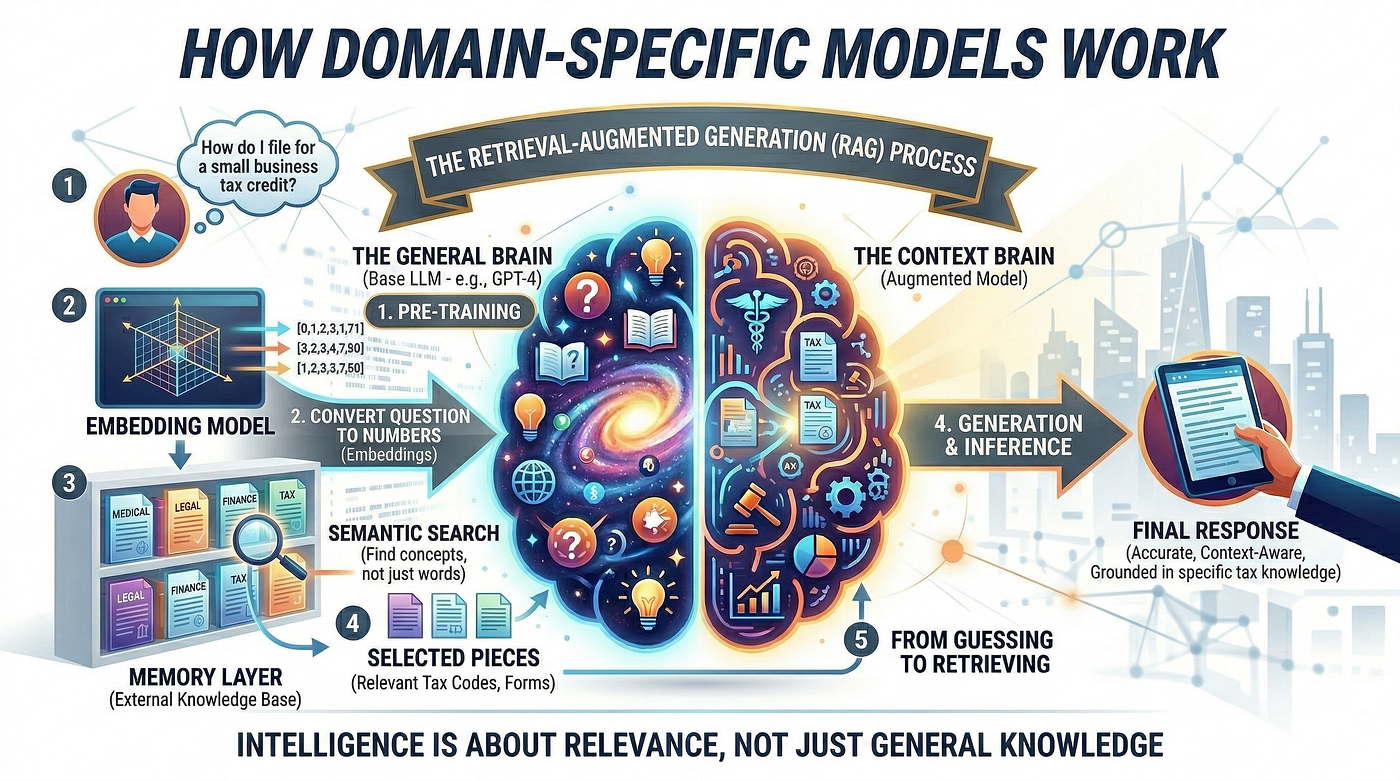
Let’s not dive into complicated jargon. Instead, think of it like this. A domain-specific AI has three main “parts,” even if you don’t see them.
First, there’s the general brain. This is the base model, something like GPT-4. This is called a foundation model or large language model (LLM). It’s trained on massive amounts of text using a process called pretraining, which helps it learn language patterns, reasoning, and structure.
Then comes the memory layer. This is where domain knowledge lives … medical research, legal documents, financial data, or internal company files. Technically, this is an external knowledge base, often stored in systems like vector databases or document stores.
Finally, there’s the retrieval system, the part that quietly does the smart work. When you ask a question, the AI doesn’t immediately answer. Instead, a few things happen behind the scenes:
Your question is converted into numbers using something called an embedding model. This process is known as embedding generation, and it helps capture the meaning of your query, not just the exact words.
- The system searches its memory to find relevant information. This step is called semantic search or vector similarity search, where it looks for content that is conceptually similar to your question.
- The most relevant pieces are selected and passed back to the model. This is often referred to as retrieval or context injection.
- Finally, the AI generates a response using both its general knowledge and the retrieved data. This step is called generation or inference.
So instead of guessing, it’s more like: “Let me find the best information I have… and then explain it clearly.” And that small shift … from guessing to retrieving … is what makes a huge difference.
RAG vs Fine-Tuning
You’ll often hear about two main ways to build these systems. Let’s simplify them.
Retrieval-Augmented Generation (RAG) This is like giving the AI a smart library and teaching it how to search. The knowledge stays outside the model. When a question comes in, the AI looks up relevant information and uses it to generate an answer.
Think of it as: “I don’t have everything memorized, but I know exactly where to find it.”
It’s useful because it’s easy to update, works well with large, changing knowledge bases, and is more transparent, you can often trace where answers come from.
Fine-Tuning This is like teaching the AI everything in advance. Here, you train the model on specific data so that the knowledge becomes part of its internal behavior.
Think of it as: “I’ve already learned this … I don’t need to look it up.”
It’s useful for consistent tone, specialized tasks, and doesn’t need to fetch external data every time.
Why This Matters (More Than You Think)
At first glance, this might sound like a technical upgrade.
It’s not. It’s a fundamental shift in how AI is actually used. Because most real-world problems are not general, they’re specific.
A doctor doesn’t need an AI that writes poetry. They need one that understands patient history. A lawyer doesn’t need quantum physics explanations. And honestly… A student probably doesn’t need an AI that perfectly drafts a text to their crush (arguable).
That’s where domain-specific AI shines.
Smaller Can Be Smarter
Here’s the part that surprises people: bigger isn’t always better.
We’ve been trained to think more parameters = better performance. But in practice, a smaller model, paired with the right data and a strong retrieval system … can outperform a massive general model on specific tasks.
Think of it like this: A general AI is someone who can cook a bit of everything. A domain-specific AI is a chef who has mastered one cuisine. If you want great pasta, you don’t pick the person who “kind of knows everything.” You pick the specialist.
Final Thoughts
There’s something familiar about this moment. In the early days of the internet, everything was centralized. Big platforms tried to do everything.
Then things evolved. We got specialized tools. Specialized platforms. Specialized services.
AI is going through that same transition. From general to specialized. From broad to focused. From impressive demos to real-world usefulness.
And if there’s one idea to take away from all this, it’s this: The future of AI is not about making it know everything. It’s about making it know the right things really well.
Intelligence isn’t just about how much you know. It’s about how relevant that knowledge is to the problem in front of you.
And that’s exactly why domain-specific AI models are not just an upgrade. They’re the next step.